
Repairing Chips and Cracks on a Gravestone in Israel: Restoration Without Slab Replacement
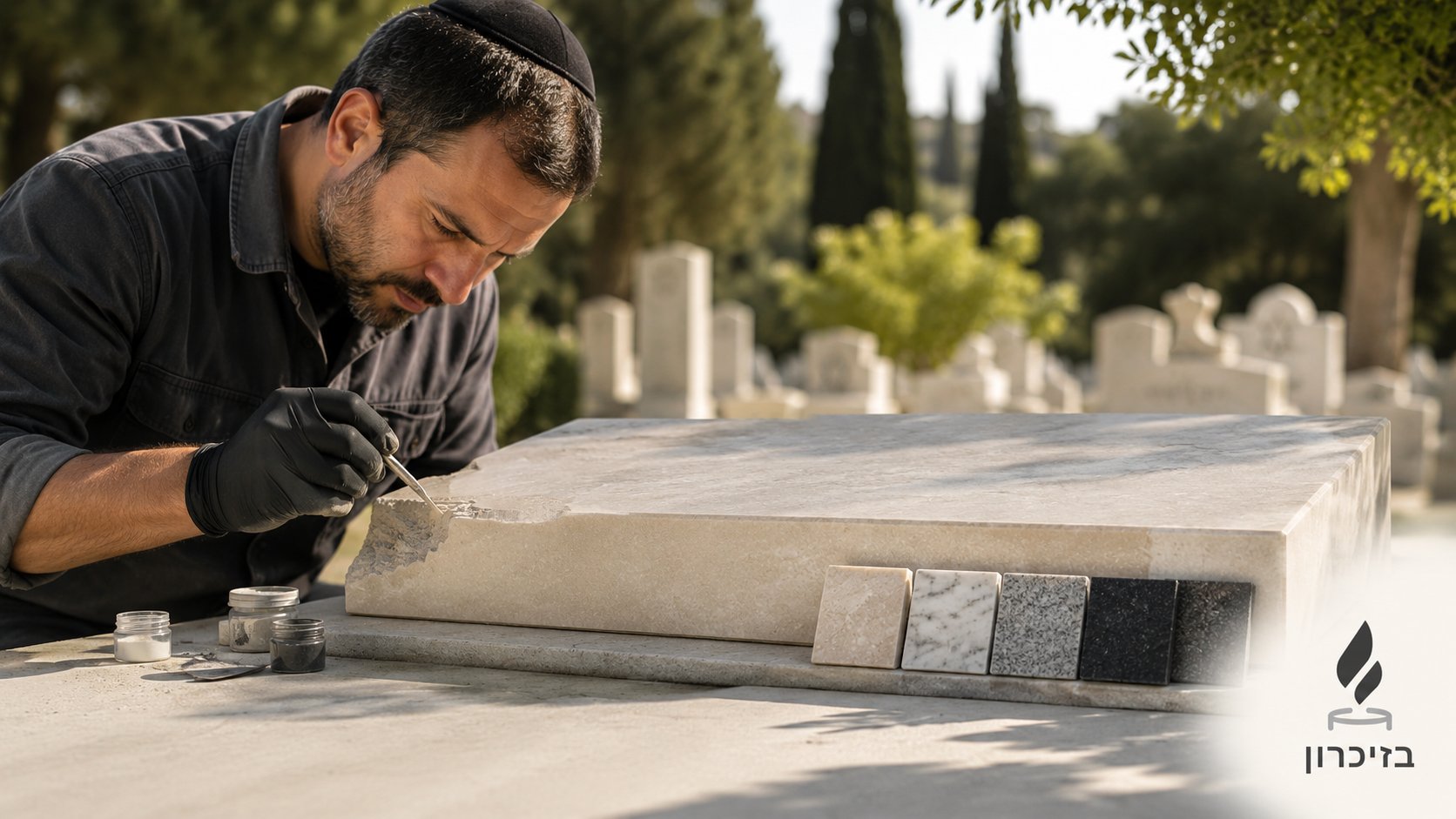
Why Chips and Cracks Appear on Gravestones
A gravestone is a complex stone structure that stands for many years under sun, moisture, temperature swings, ground movement, and external forces.
In Israel, gravestones usually consist of several slabs and elements, so chips, cracks, damaged corners, and other defects can appear during installation, maintenance, replacement of individual parts, or simply with natural use.
Sometimes the damage occurs during assembly or dismantling. Sometimes it results from movement of the base, vibration, a mechanical impact, falling objects, or the natural aging of materials.
Even a small chip can noticeably mar the gravestone's appearance — especially if the damage sits in a visible spot: on a corner, the front slab, the top of the structure, or near the inscription.
Why the Slab Does Not Always Need Replacing
Very often, when a chip or crack appears, gravestone owners are offered the most expensive option — full replacement of the damaged slab.
In some cases this is genuinely necessary, especially if the stone is seriously destroyed or the structure has lost its strength. But in many situations, replacement can be avoided.
Bezikaron has developed a dedicated technology for repairing chips, corners, and cracks on different types of gravestones, including Hebron stone, Turkish marble, grey granite, and black granite.
This approach returns a neat appearance to the gravestone without full replacement of the element — saving the family significant cost and shortening the work timeline. For relatives abroad arranging repairs remotely, it also means a far simpler process: no stone sourcing, no dismantling, no re-installation to coordinate from a distance.
What Damage Can Be Repaired
Professional restoration can address various types of damage:
- chips on the corners of the gravestone;
- cracks in the slabs;
- minor damage to the front face;
- broken-off fragments of stone;
- defects left by poor-quality installation;
- damage after dismantling or replacing elements;
- minor deterioration at the slab joints;
- visual defects on Hebron stone, Turkish marble, grey granite, and black granite.
Before work begins, the specialists assess the gravestone's condition and determine whether restoration is possible without replacing the slab.
Color and Tone Matching in Chip Repair
One of the most important parts of repairing chips and cracks is precise matching of the color, tone, and shade of the restoration compound.
It is not enough simply to fill the damaged spot with material. If the color is matched incorrectly, the restored area will stand out on the surface and be immediately noticeable.
The particularities of each type of stone matter greatly here.
Turkish marble often carries natural veins, transitions of grey, and lighter and darker zones. When repairing chips, the specialists must match not only the base color but the stone's overall tone, depth, shade, and natural pattern.
The same applies to Hebron stone. It can show beige, grey-beige, yellowish, and lighter tones. For the restored area to look natural, the compound must be matched to the specific gravestone rather than using a universal color.
Black granite has its own nuances. Despite its name, black granite varies in depth of color: from saturated black to a darker grey. Sometimes restoration calls for a deeper black tone, and sometimes for a soft grey transition, so the area does not stand out against the overall surface.
Grey granite likewise demands precise shade matching. Its surface can contain black flecks, fine speckles, grey transitions, and zones of varying intensity. The restoration compound is therefore matched individually to the specific stone.
Bezikaron pays special attention to the color and shade matching of restoration materials. We match the compound individually to every gravestone, accounting for the type of stone, its age, the degree of fading, its natural pattern, and the nature of the damage.
It is precisely this approach that allows chips, corners, and cracks to be restored as neatly as possible — so the gravestone looks natural and keeps a dignified appearance without full slab replacement.
Repairing Chips on Hebron Stone
Hebron stone is a fairly porous limestone, so its restoration requires a particular approach.
When working with this material, it is important not only to fill the damaged spot but to select a compound compatible with the stone's structure, shade, and texture.
Bezikaron's specialists use professional materials and a methodology that restores damaged areas so they blend as harmoniously as possible with the overall surface of the gravestone.
After restoration, the area can be additionally treated, cleaned, and protected with special compounds to reduce the risk of further deterioration.
Repairing Chips on Turkish Marble
Turkish marble has a denser structure than Hebron stone, but it too demands careful work.
On this stone it is especially important to match the shade of the restoration material correctly, since the grey veins and natural pattern of the marble make every gravestone unique.
Unprofessional repair can leave a visible stain, an uneven patch, or an area that differs in color from the base stone. The work must therefore proceed in stages: preparing the damaged area, cleaning, color matching, applying the restoration compound, leveling, and final surface finishing.
Properly executed restoration significantly improves the gravestone's appearance and avoids full slab replacement.
Repairing Chips on Grey Granite
Grey granite is widely used in Israel, with its characteristic grey color, black flecks, and fine speckles.
When repairing chips on this stone, it is important to account not only for the overall grey shade but for the surface structure. If the compound is too light, too dark, or too uniform, the restored area can stand out against the granite's natural pattern.
Bezikaron's specialists therefore match the restoration materials to the color, texture, depth of damage, and location of the chip.
After restoration, the area is additionally finished and brought to a neat appearance, so the gravestone preserves its integrity and looks natural.
Repairing Chips on Black Granite
Black granite is considered one of the strongest and most premium gravestone materials, yet chips can appear even here — especially on the corners and edges of the slabs.
The main challenge with black granite is preserving the depth of color, the luster, and the uniformity of the surface.
Bezikaron uses dedicated restoration technologies that carefully treat the damaged area, rebuild the shape of the corner or edge, and then perform a final polish.
In some cases the right match is not absolute black but a darker grey, so that the restored area does not differ from the rest of the gravestone's surface.
This approach preserves the gravestone's premium appearance without replacing the entire slab.
The Chip and Crack Repair Process
Repairing damage on a gravestone requires a consistent professional approach.
First, the specialists clean the damaged area of dust, old materials, dirt, and loosened fragments of stone.
The surface is then prepared for the restoration compound. Depending on the type of stone and the nature of the damage, a special material is selected to fill the chip, rebuild the corner, or close the crack.
The area is then leveled, finished, and brought to the most natural possible appearance.
The final stage depends on the gravestone's material: delicate finishing and protection for Hebron stone, careful resurfacing for Turkish marble, structure-aware treatment for grey granite, and polishing with luster restoration for black granite.
Saving the Budget Without Sacrificing Quality
Replacing a slab is an expensive and complicated process. It requires sourcing matching stone, dismantling the old element, fabricating a new slab, reinstalling it, and fitting it to the existing structure.
In many cases, professional restoration avoids these costs entirely.
Repairing chips and cracks preserves the existing gravestone, returns it to a dignified appearance, and extends the structure's life without full replacement of elements.
This is especially important when the gravestone is made of rare stone, has a complex shape, carries old engraving, or holds deep emotional value for the family.
When to Call the Specialists
If a chip, crack, or damaged corner has appeared on the gravestone, do not attempt to fix it yourself — or ask someone locally to improvise a repair.
Household adhesives, cement mixes, and unsuitable materials only make things worse. They usually differ in color, bond poorly with the stone, deteriorate quickly, and make the damage even more visible.
It is better to go straight to specialists who can assess the gravestone's condition, match the right shade of restoration compound, and propose the most suitable repair method.
Bezikaron — Gravestone Restoration Without Unnecessary Replacement
Bezikaron repairs chips, corners, and cracks on gravestones throughout Israel.
We work with Hebron stone, Turkish marble, grey granite, black granite, and other materials, using professional compounds and technologies that return a neat, dignified appearance to the gravestone.
Our goal is not simply to mask the damage, but to restore the gravestone as carefully as possible — preserving its structure, its appearance, and its meaning for the family.
If chips, cracks, or corner damage have appeared on a gravestone, the slab does not always need replacing. In many cases, professional restoration with correct matching of color, shade, and compound returns the gravestone to a dignified appearance — and saves the family a substantial part of the budget.