
Engravings and Photo Portraits on Stones in Israel: Engraving, Photo Ceramics, and Personalized Design
A Stone's Individuality: More Than an Inscription
A stone is not only stone, a name, and dates. It is a place of memory, where a family seeks to preserve the image of a person: their character, their defining traits, their passions, their life's path.
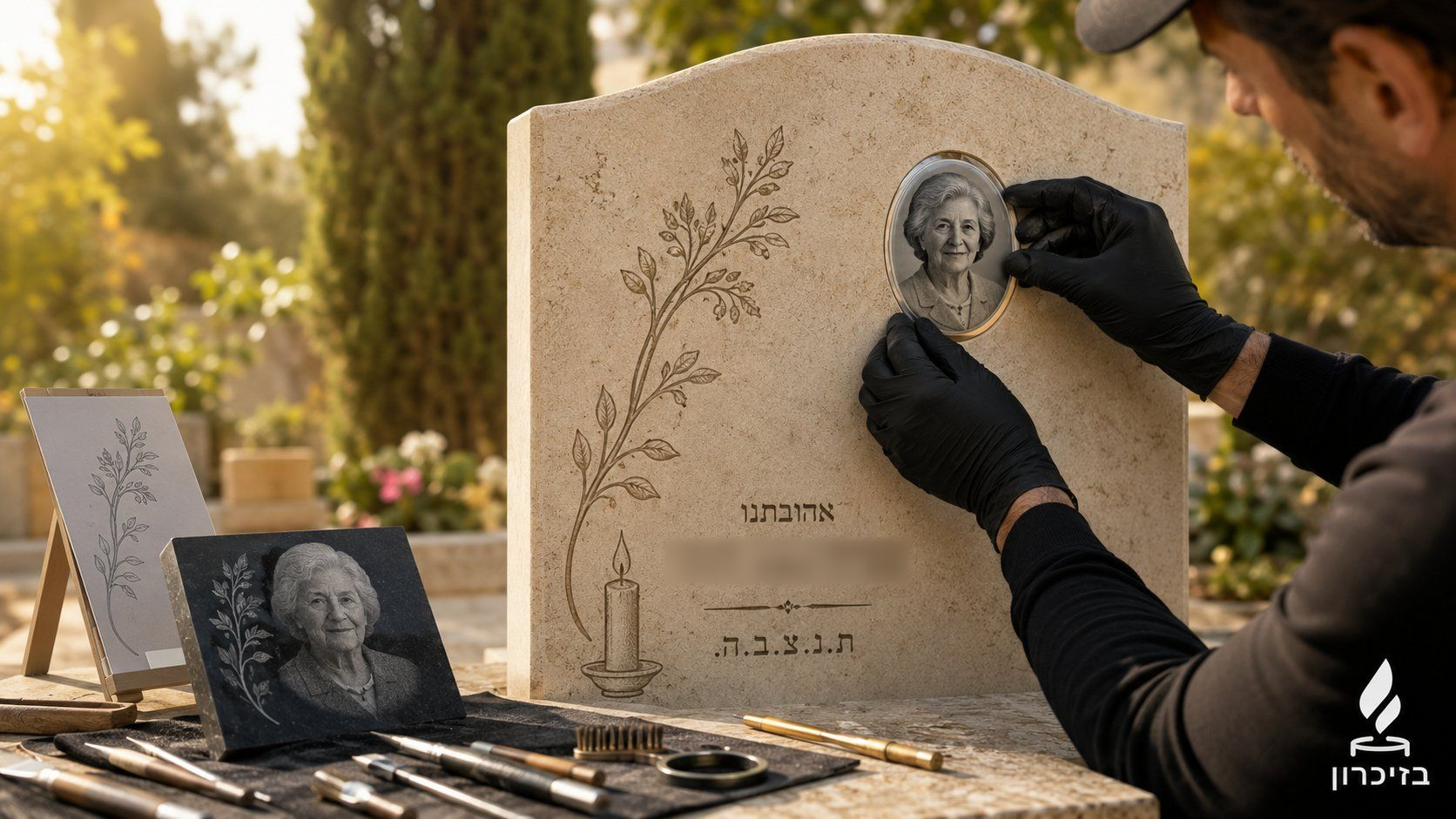
That is why many families want to complement the stone not only with text, but with visual elements: drawings, symbols, ornaments, photo portraits, or photo ceramics.
These details make a stone more personal and individual. They help convey what words alone cannot: love for the person, their profession, their faith, their character, their values, or the family's most cherished memories.
What Designs Can Be Engraved on a Stone
Various decorative designs can be used on stones in Israel: religious symbols, floral elements, branches, candles, books, musical instruments, images of nature, professional emblems, or any other element reflecting the person's individuality.
Before engraving, the specialists prepare a mock-up. At this stage, the size, shape, style, placement, and overall look of the future image are discussed with the client.
A visual proof is then sent for approval, so the family knows exactly how the design will appear on the stone, particularly convenient for relatives abroad, since the entire approval process happens remotely.
Only after the shape, size, and placement are approved is the image transferred to the surface of the stone and applied by the chosen engraving method.
Methods of Applying Designs to a Stone
Designs are most often applied to stones in two main ways: sandblast engraving or laser engraving.
Sandblast Engraving
Sandblast engraving is one of the most common methods of applying images to stone.
First, a special template with the approved design is prepared. The image is then transferred to the chosen area of the stone, and the engraving is formed using sandblasting equipment.
This method produces crisp, expressive images and suits most types of stone used in Israel.
Laser Engraving
Laser engraving is used when finer lines, intricate elements, or a highly detailed design are needed.
The machine applies the image with high precision, producing a clean, contemporary result.
The choice of method always depends, however, on the type of stone, the complexity of the design, the desired result, and the rules of the specific site.
Colored Designs on Stones
On Hebron stone, Turkish marble, and grey granite, engraved designs can additionally be painted.
This makes the image more visible, expressive, and personal. Colors are chosen at the client's request and approved in advance.
A design can be executed in a single color or several shades, if this suits the stone's overall look and does not conflict with the site's rules.
Professional painting requires careful surface preparation, the right choice of paint, and precise application, so that the image keeps its appearance over time.
Designs on Black Granite
Black granite holds a special place among stone materials.
Multicolored designs are rarely used on it, since the stone's deep black color itself creates strong visual contrast. Images on black granite are most often executed as engraving without additional coloring.
At the same time, it is black granite that serves as the primary material for high-quality photo engraving.
Photo Engraving of a Portrait
Photo engraving is the application of a person's portrait directly onto the surface of the stone. This method preserves not only a name, but the person's image: their face, their gaze, their individuality.
Bezikaron performs photo portrait engraving on black granite using professional technology.
Before such work, however, it is essential to check the rules of the specific site. At many sites in Israel, portraits on stones are prohibited or restricted by internal regulations.
Before ordering photo engraving, it is therefore important to confirm in advance that such a design is permitted at the chosen site.
A Solution for Sites Where Portraits Are Prohibited
Bezikaron has developed a special solution for cases where an open portrait on the stone is not possible due to site rules.
It is a special element in the form of a closing book. In its normal state, the portrait is not visible on the stone, as it is closed. When desired, it can be opened to reveal the photo engraving inside.
This solution preserves the personal image of a family member while respecting the restrictions in force at some Israeli sites.
Photo Ceramics on a Stone
Another form of personalization is photo ceramics.
A photo-ceramic portrait is an image applied to a special ceramic base. The element can be made in various sizes and installed on the stone, provided this is permitted by the site's rules.
Bezikaron professionally produces photo-ceramic portraits for stones. The client can send a photograph to the company's specialists, after which the image is processed and prepared for production. Everything can be done by email or messenger, with no need to be in Israel.
If necessary, we enhance the quality of the photograph, retouch the image, and prepare it so that the final portrait looks as crisp, clean, and dignified as possible.
To improve old or imperfect photographs, modern digital technology can be used, including AI-based tools. This restores detail, sharpens the image, and prepares it for transfer to photo ceramics.
Correct Installation of Photo Ceramics
The quality of photo ceramics depends not only on the image itself but on correct installation.
Unprofessional mounting can cause the element to detach, shift, or come unglued over time.
Before installation, the surface of the stone must be properly prepared. If the photo ceramic is mounted on a polished surface, that area must be specially treated. In some cases the polished layer is carefully removed with professional equipment to create a reliable seat.
The surface is then cleaned, degreased, and prepared for mounting.
The photo ceramic is then set on a special professional compound that ensures a secure, durable bond.
Why This Work Should Be Entrusted to Professionals
Applying designs, photo portraits, and photo ceramics to a stone requires not only artistic taste but technical experience.
The type of stone, the site's rules, the engraving method, the quality of the photograph, proper surface preparation, and the mounting technology must all be taken into account.
Mistakes at any stage can leave the design looking untidy, degrade the portrait, or cause the photo ceramic to detach over time or damage the surface of the stone.
Bezikaron accompanies the client through every stage: from choosing the image and preparing the mock-up, through approval and production, to engraving and professional installation.
Memory Expressed in the Details
Designs, symbols, and photo portraits make a stone truly personal.
They preserve not only a person's name, but part of their character, their story, their faith, their profession, their passions, and their life's path.
Professional design engraving, photo engraving on black granite, and photo ceramic installation create an individual memorial that will honor the memory of a family member for years to come.
Bezikaron uses modern technology, professional materials, and attention to every detail, so that the stone is not merely beautiful, but truly personal and meaningful for the family.