
Stone Joints in Israel: Sealing, Crack Repair, and Structural Protection
Why Stone Joints Demand Special Attention
A stone in Israel is most often not a single solid block but a complex structure assembled from several slabs. Such stones can consist of 8–12 separate elements, joined together to form a single memorial structure.
This is why the joints between the slabs are among the most important parts of the stone. Their condition determines not only the appearance but the strength of the entire structure.
Over time, cracks, gaps, slab separation, and the breakdown of old jointing materials can appear at the seams. If this goes unnoticed, the stone can gradually begin to lose its stability, and for families abroad, the first warning sign is often a hairline crack spotted in a photograph.
Why Stone Joints Crack
Israel lies in a region where ground movement and seismic activity are possible. In addition, stones are affected by vibration, humidity, temperature swings, precipitation, settling of the base, and the natural aging of materials.
Even small ground shifts can, over time, create stress at the points where the slabs join.
As a result, the joints begin to crack, the old sealant peels away, and open seams appear between the elements of the stone.
This happens especially often on multi-part stones, where each slab carries part of the structure's overall load.
Why Open Joints Are Dangerous
At first glance, a small crack in a joint may seem a purely cosmetic problem. In practice, it is one of the first signs that the structure needs attention.
Through open joints, moisture, dust, dirt, and biological contamination begin to penetrate inside the stone. Over time this weakens the bond between the slabs and accelerates the structure's deterioration.
Without timely joint sealing, the slabs can begin to drift apart. This can eventually lead to serious damage, the need to fully reassemble the stone, or the replacement of individual elements.
This is why joint restoration should be carried out early, before the damage becomes critical.
Sealing Stone Joints
Joint sealing is a professional procedure that closes the seams between the slabs, protects the stone from moisture, and prevents further deterioration of the structure.
Ordinary household sealants or unsuitable construction mixes must not be used for this work. They can quickly lose elasticity, crack, discolor, or bond poorly with the stone.
Bezikaron uses special two-component mastics and professional sealants designed for stone and memorial structures.
These materials reliably close the joints, preserve the strength of the bond, and extend the life of the stone.
Bezikaron's Joint Restoration Technology
Joint restoration requires proper preparation and consistent execution of every stage.
Stage One: Assessing the Stone's Condition
First, the specialists evaluate the structure: they check the joints, look for cracks and slab separation, examine the old materials, and assess the overall condition of the connections.
This determines whether only local sealing is needed or deeper structural work is required.
Stage Two: Removing Old Materials
Before applying a new compound, the remains of old sealant, cement, mastic, or any other previously used materials must be removed.
If a new compound is applied over an old, deteriorated layer, it cannot bond reliably and will quickly begin to peel.
Proper stripping is therefore an obligatory step.
Stage Three: Cleaning and Degreasing
After the old materials are removed, the joint area is thoroughly cleaned of dust, dirt, and residual contamination.
The surface is then degreased so that the new sealant or two-component mastic bonds firmly with the stone.
Many contractors skip this step, yet it is precisely this stage that largely determines the durability of the result.
Stage Four: Applying the Mastic or Sealant
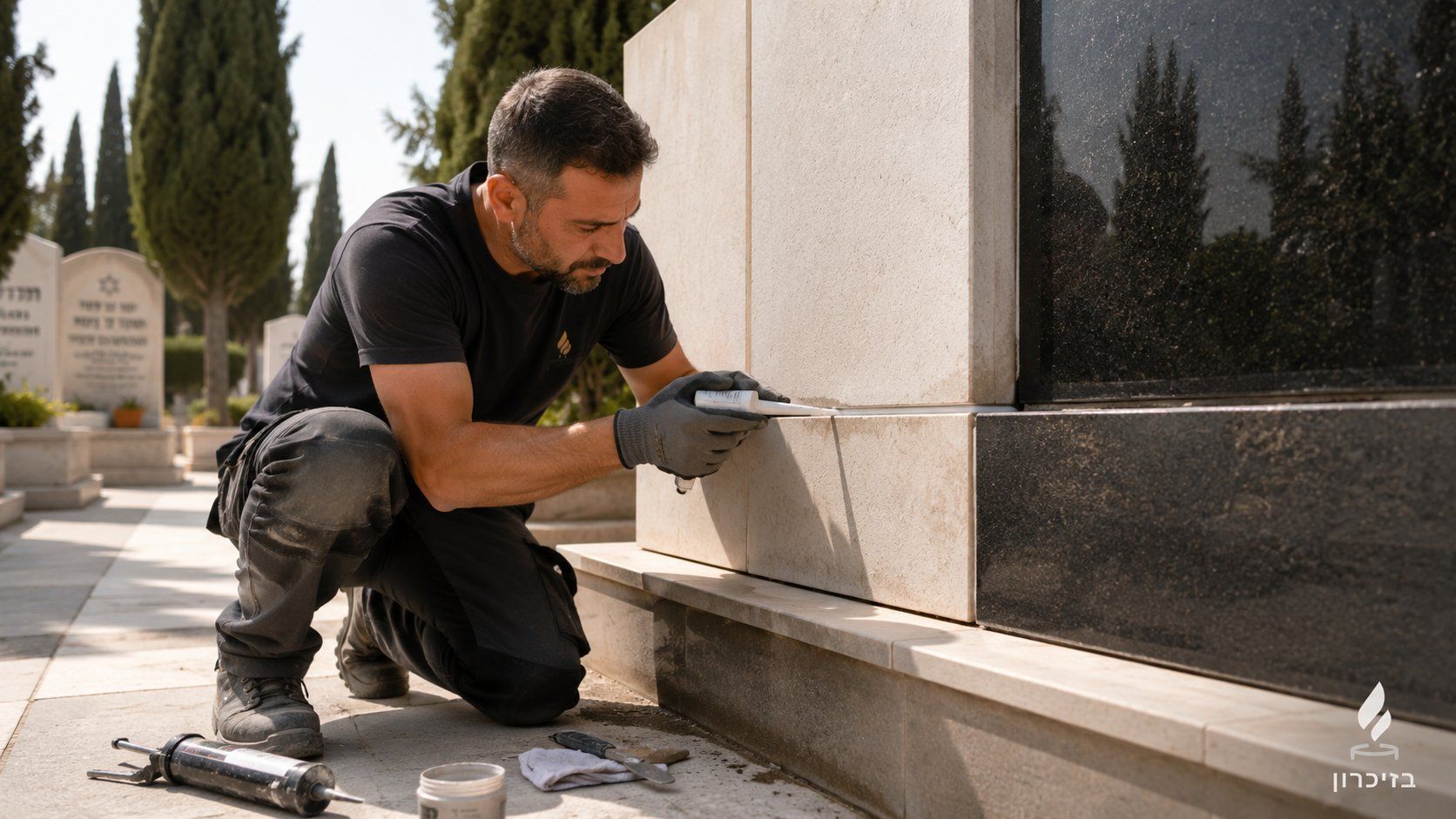
After preparation, the specialists apply a professional two-component mastic or a dedicated sealant.
The material is carefully worked into the joint, fills the voids, and closes the seam between the slabs.
The point is not simply to smear over the crack from the outside, but to fill the problem area correctly, protecting the structure against further penetration of moisture and contamination.
Stage Five: Final Finishing
After application, the joint is carefully leveled so that it looks clean and even and does not detract from the stone's appearance.
Properly executed sealing should be not only strong but aesthetically pleasing.
Why Joint Restoration Should Not Be Postponed
Once the joints have begun to crack, the problem rarely resolves itself.
On the contrary, the damage grows over time. Moisture keeps penetrating the structure, the slabs gradually separate, and the load is distributed incorrectly.
The stone can begin to deform, individual elements can crack under their own weight, and the entire structure may require major repair.
In some cases, the stone must be completely dismantled, reassembled, and its damaged parts replaced.
Timely joint sealing avoids these consequences and keeps the stone in stable condition.
Professional Care for Stone Joints
Stone joints should be inspected periodically, especially if the stone was installed many years ago or stands on unstable ground.
Regular inspection allows the first signs of deterioration to be caught in time: fine cracks, voids, slab separation, or peeling of old sealant. For families overseas, this is one of the strongest arguments for a regular professional care arrangement: a trained eye on site notices what a photograph cannot show.
Bezikaron carries out joint restoration and sealing on stones in Israel using professional materials and correct surface preparation technology.
This approach preserves the strength of the structure, prevents deterioration, and extends the life of the stone.
Joint Sealing Is the Protection of Memory
A stone is not merely a stone structure. It is a place of memory, respect, and a family's bond with a family member.
For it to retain a dignified appearance and structural strength for many years, it is important to watch not only the cleanliness of the stone but the condition of the joints.
Timely sealing, crack repair, and professional treatment of the seams prevent serious damage and keep the stone in its original condition for years to come.
Bezikaron uses special two-component mastics, professional sealants, and a proven joint restoration technology so that stones remain strong, neat, and reliably protected from deterioration.