
Grey Granite in Israel: Cleaning Granite Stones, Stain Removal, Polishing, and Stone Protection
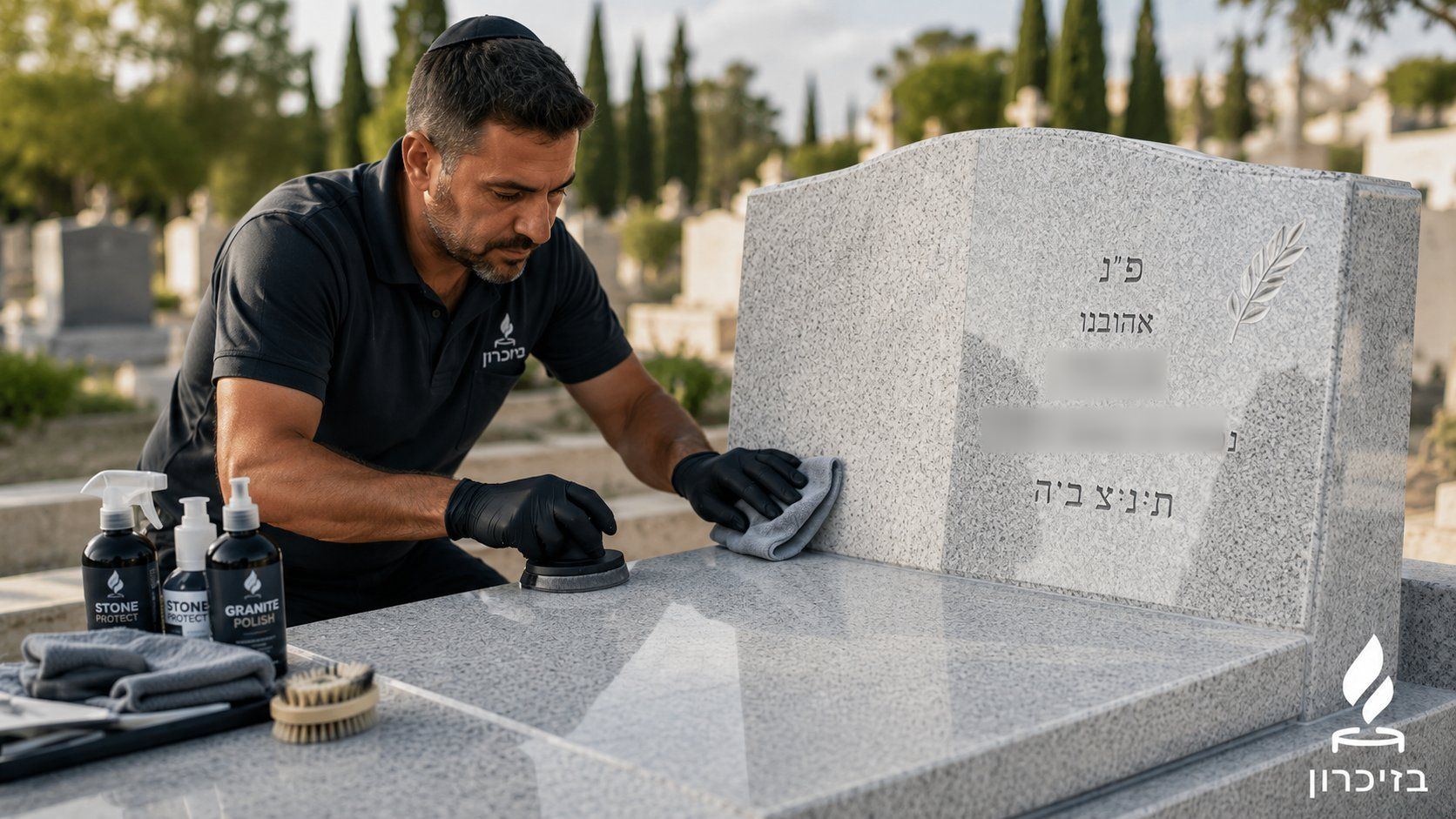
Grey Granite: a Popular Stone Material in Israel
Grey granite is one of the common materials for stones in Israel. It is easy to recognize by its characteristic grey color with black flecks and small speckles that form the stone's natural pattern.
In terms of cost, grey granite sits in the mid-range. It is more expensive than Hebron stone and Turkish marble, but among granites it is considered one of the more affordable options.
Thanks to its combination of strength, understated appearance, and relatively accessible price, grey granite is often used for stones, slabs, bases, and combined memorial structures.
But although granite has a reputation for toughness, grey granite has particular characteristics that must be taken into account when caring for, cleaning, or restoring a stone.
What Makes Grey Granite Different
The main characteristic of grey granite is its porosity.
Among granites, grey granite is considered one of the most porous. This means its surface can absorb certain substances, especially those with an oily base.
At first glance the stone may look dense and resilient, but with improper care, contamination can penetrate quite deep into the structure of the material.
This is why cleaning grey granite stones requires a professional approach and special products that contain no oily components.
Why Grey Granite Should Never Be Cleaned with Household Products
One of the most common mistakes is attempting to clean the stone with household products.
Many people use soap, all-purpose cleaners, or other products not intended for natural stone. If such a product has an oily base, grey granite can absorb it.
Dark stains then appear on the surface and penetrate deep into the stone. Removing them with ordinary cleaning is practically impossible.
Unlike surface dirt, oil stains do not stay on top. They sink into the structure of the granite, and over time become a permanent defect in the stone's appearance.
If you live abroad and a relative or friend offers to "freshen up" the family plot with whatever cleaner is at hand, this is exactly the scenario to avoid. For grey granite, only professional products should ever be used.
Stains from Candles and Paraffin
A separate problem with grey granite is candle marks.
It is common to place memorial candles directly on the stone. With grey granite, however, this can seriously damage the surface.
Paraffin has an oily base. If a candle falls over, melts down, or even a single drop of paraffin lands on the stone, the granite can absorb it into its structure.
Dark stains then form on the surface, stains that are almost impossible to remove completely.
For this reason, candles should not be placed directly on the surface of a grey granite stone. It is far better to use dedicated stands, memorial lamps, or separate elements that keep wax and paraffin from ever touching the granite.
What to Do If Stains Have Already Appeared
If grey granite has already absorbed an oily substance, removing the stain completely can be extremely difficult.
Bezikaron has developed a special tone-evening technology for cases where the stone has already been damaged by oil or paraffin stains.
This technology is not ordinary cleaning. Its purpose is to visually even out the surface and make the stains as inconspicuous as possible, given how deeply the contamination has penetrated.
This is precisely why it is so important not to let the stone reach that state, and to apply proper stone protection in advance.
Cleaning Grey Granite
Professional cleaning of grey granite follows a specific protocol.
First, the stone is cleared of surface dirt, dust, weathering marks, and loose deposits.
Then a special cleaning product, one containing no oily base, is applied.
Critically, such products must never be left on grey granite for long. In Bezikaron's protocol, the compound stays on the stone for a strictly limited time (no more than a few minutes) and is then removed from the surface immediately.
This approach cleans the stone without damaging its structure and without any risk of the chemical components themselves being absorbed.
Removing Rust and Metal Marks
Rust stains can appear on grey granite.
This usually happens when metal objects, decorative elements, contaminated dust, or iron particles sit on the surface of the stone for a long time.
Under the influence of moisture, these elements begin to oxidize, leaving orange or brownish marks on the stone.
To remove such stains, Bezikaron's specialists use dedicated professional compounds that lift the rust and restore the surface.
Here too, technique is everything: the product must remain on the stone for a strictly limited time and be removed as soon as the reaction is complete.
Why Grey Granite Must Not Be Ground Down
Unlike some other types of stone, grey granite is not treated with conventional grinding or honing.
To restore its appearance, a special three-stage polishing process is used instead.
Improper grinding can damage the surface, alter the structure of the stone, and ruin its appearance. The work must therefore be done only by specialists who understand the specific behavior of grey granite.
Three-Stage Polishing of Grey Granite
To restore the surface of grey granite, Bezikaron uses a three-stage polishing technology.
The work is performed with dedicated polishing discs and professional compounds designed for this type of stone.
The first stage prepares the surface and removes some of the superficial defects.
The second stage evens out the visual condition of the stone and returns a more uniform appearance.
The third stage completes the treatment, enhances the natural luster, and gives the stone a neat, well-kept look.
This polishing restores the stone's appearance without aggressive impact on the structure of the stone.
Protecting Grey Granite
After cleaning and polishing, grey granite absolutely must be protected.
Bezikaron uses a special protective product applied according to a defined protocol.
First, the compound is distributed evenly across the surface of the stone. The stone is then covered with a special film that allows the product to work properly and interact more deeply with the surface.
After 24 hours, the film is removed and the residue of the protective compound is carefully cleaned away.
This method creates a protective barrier that reduces the risk of moisture, dirt, paraffin, and other substances penetrating the structure of the grey granite.
Professional Care for Grey Granite
Grey granite is a strong and handsome material, but it demands informed care.
The biggest mistake stone owners make is cleaning it themselves with unsuitable products. Soap, household chemicals, and anything with an oily base are especially dangerous.
It is also best not to place candles directly on the surface of the stone, since paraffin can leave deep stains.
Professional cleaning of grey granite stones, correct three-stage polishing, and quality protection keep the stone in good condition for many years.
Bezikaron uses dedicated technologies for grey granite, accounting for its porosity, its sensitivity to oily substances, and the specific requirements of restoring its surface.
This approach preserves the stone's dignified appearance, and with it, a careful, lasting tribute to your family, wherever in the world you may be.