
Grey Granite in Israel: Engraving, Letter Painting, and Inscription Restoration on Stones
The Inscription: the Heart of the Memorial
On any stone, the inscription is the principal element identifying a person. The name, the dates of a life, words of remembrance, lines of prayer, or a personal message from the family turn stone into a personal memorial that preserves the memory of a family member for years.
The quality of the lettering, correct engraving, and professional painting therefore matter greatly. This is especially true with grey granite, a material widely used in Israel that has its own technical particularities.
Grey granite is considered a strong and durable stone, but improper treatment, poor-quality painting, or unprofessional letter installation can cause the inscription to quickly lose its appearance or require costly restoration, something families abroad often discover too late, from a photograph of the plot.
Grey Granite and Its Lettering Characteristics
Grey granite is easy to recognize by its characteristic grey color with black flecks and fine speckles. It is often used for stones in Israel, combining strength, an understated look, and relatively accessible cost among granites.
At the same time, grey granite has important particularities. Among granites it is considered one of the most sensitive to improper care and treatment. Its surface can absorb certain substances, especially those with an oily base.
When inscribing, painting letters, or restoring, it is therefore essential to use only professional materials and precise techniques. Mistakes on this stone show immediately, and last.
The Main Lettering Methods on Grey Granite
Several principal technologies are used on grey granite stones in Israel.
Sandblast Engraving
Sandblast engraving is one of the most common methods of lettering grey granite.
First a template with the approved text is prepared. Then, using pressurized sandblasting equipment, the letters are cut into the surface of the stone.
The advantage of this method is that the craftsman controls the depth of the engraving. The more correctly the stone is cut, the better the letters hold paint, and the simpler future restoration of the inscription becomes.
Sandblast engraving suits grey granite well, provided the work is done professionally and with the material's particularities in mind.
Machine Engraving
The second common option is machine engraving.
Here the inscription is applied with specialized equipment that achieves high precision and clean letterforms.
This method suits straight, crisp inscriptions and is often used in the production of modern stones.
It is important, however, that any machine engraving be cut to the correct depth with future painting in mind. If the letters are too shallow, the paint will hold less well over time and restoration will become more complicated.
Raised (Negative) Engraving on Grey Granite
Raised (or "negative") engraving deserves separate attention.
It is a fairly common style on grey granite stones. With this technology, it is not the letter that is cut but the background around it. The letters remain, as it were, on top, at the original level of the polished surface, while the background becomes recessed and unpolished.
This type of engraving looks expressive and reads well, especially on grey granite. The contrast between the polished surface of the letters and the matte recessed background gives the inscription volume and depth.
Raised engraving, however, demands particular care in painting and restoration.
After treatment, the unpolished background becomes more susceptible to grime and paint. If paint accidentally lands on the recessed background, removing it is extremely difficult. In some cases the paint soaks in so deeply that returning the stone to its original appearance is no longer possible.
This is why painting letters on stones with raised engraving should never be attempted on one's own. The work requires professional experience, proper surface protection, and careful application of paint.
Brass Letters on Grey Granite
Another lettering method on grey granite is brass letters.
The letters are fabricated separately and installed on the surface of the stone.
The main mistake many installers make is simply gluing the letters to the stone. On grey granite this approach is especially risky. The polished surface does not hold adhesive well over time, and under sun, moisture, and temperature swings the bond gradually weakens.
Within a few years, the letters can begin to loosen or fall off.
Bezikaron uses the correct brass-letter installation technology. Each letter must have its own seat and dedicated mounting elements. A template is prepared in advance, precise holes are drilled, and the letters are then set on dedicated mounts and additionally secured with a professional compound.
This method delivers a far more reliable and durable installation than simple gluing.
Why Letters on Grey Granite Lose Their Appearance
Even well-executed lettering can lose saturation and crispness over time.
The condition of the letters is affected by sun, moisture, dust, temperature swings, candle marks, improper cleaning of the stone, and unsuitable paints.
Problems arise especially often after unprofessional touch-ups. If the surface was not degreased, the paint was applied in a single coat, or the wrong brushes were used, the finish quickly starts to look untidy.
It is also important on grey granite to remove excess paint correctly. Improper handling can damage the polished surface, leave marks, or dull the stone's luster.
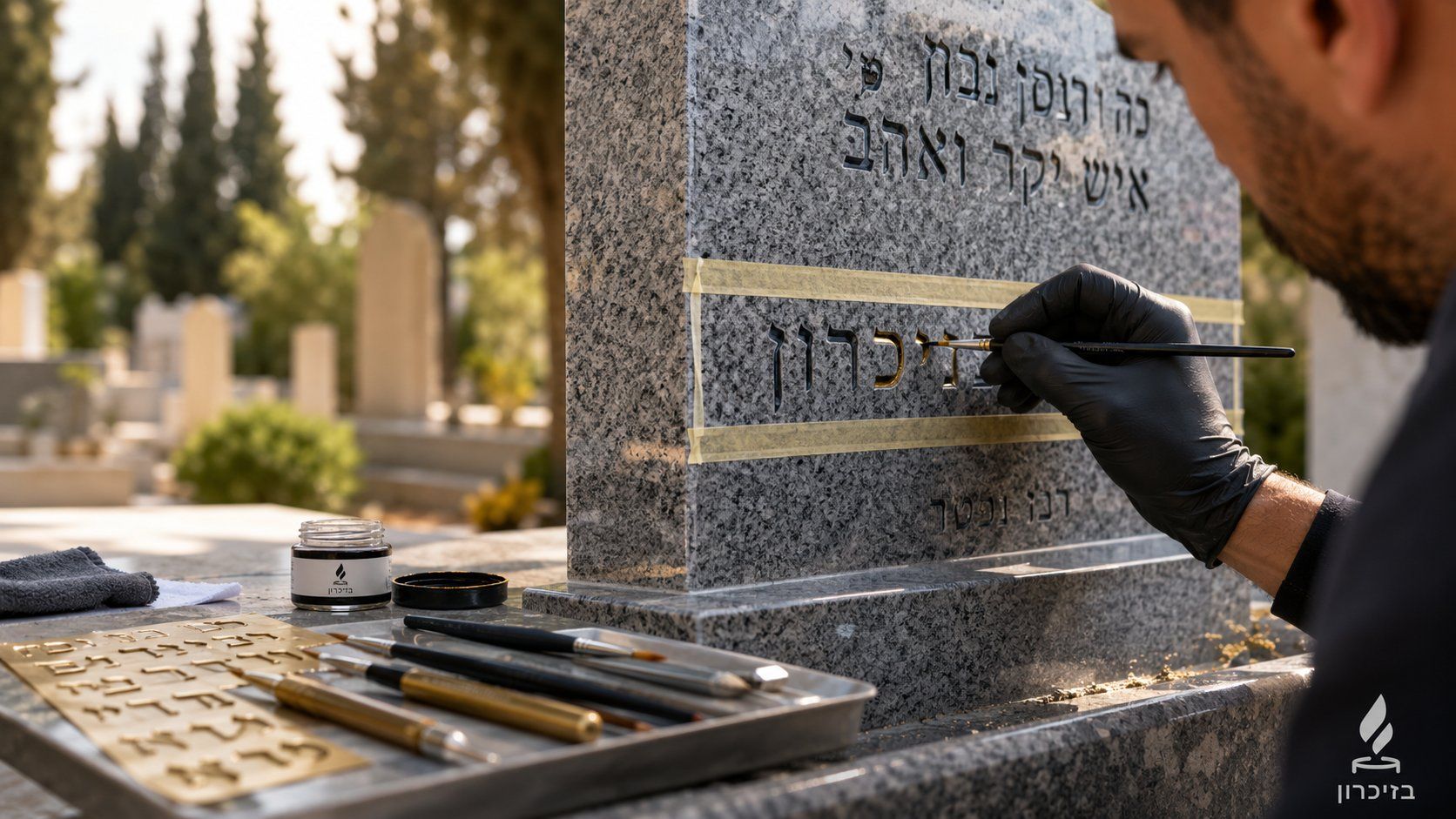
Painting Letters on Grey Granite
Painting letters on grey granite requires strict adherence to technique.
Bezikaron uses a professional methodology similar to the one applied on Hebron stone and Turkish marble, adapted to the particularities of a granite surface.
The first stage is protecting the stone. Every area that must not receive paint is masked with dedicated protective materials.
The second stage is cleaning and degreasing the letters. This is one of the most critical steps. If degreasing is skipped, the paint may apply unevenly or begin to peel within a short time.
After preparation, the first coat of paint is applied. A technical pause follows, allowing the material to set properly.
The second coat is then applied, ensuring color saturation, coverage density, and a durable result.
The Importance of the Right Brushes and Careful Application
When painting letters on grey granite, the tool matters as much as the paint.
Random household brushes must not be used. They can leave bristles, fibers, and uneven marks inside the letters. Once dry, these defects become visible, spoil the look of the inscription, and may require repainting.
Bezikaron's specialists use dedicated lint-free brushes that allow precise paint application even in small, deep areas of the engraving.
This is especially important when working with fine letters, intricate typefaces, and raised engraving.
Removing Excess Paint and Final Polishing
After painting, excess paint must be properly removed from the surface of the stone.
On grey granite this stage demands particular care. Aggressive methods that could damage the polish or leave visible marks on the stone must not be used.
Bezikaron applies special products and professional finishing that remove the excess paint without damaging the surface.
The area is then carefully polished to restore the stone's brightness, cleanliness, and well-kept appearance.
It is precisely this correct final finishing that distinguishes professional restoration from ordinary touch-up painting.
Restoring Brass Letters
If brass letters are installed on the stone, their restoration is carried out separately.
When necessary, the specialists carefully remove the letters, clean their seats, restore the letters themselves, and prepare the surface for reinstallation.
After restoration, the letters are mounted back with the correct fastening technology.
This approach not only returns a neat appearance to the inscription but also extends the service life of the mounting.
Professional Inscription Restoration on Grey Granite
Grey granite is a strong and handsome material, but lettering work on it demands experience and care.
Sandblast engraving, machine engraving, raised engraving, and brass letters can all look very dignified, if executed correctly from the start and maintained professionally.
Painting letters on grey granite must include mandatory surface protection, degreasing, two-coat paint application, the right brushes, and careful removal of excess paint.
Bezikaron uses professional technologies for restoring inscriptions on grey granite stones in Israel. This approach preserves the crispness of the letters, the neat appearance of the stone, and a dignified memory of a family member for years to come.