
Engraving, Painting, and Restoring Letters on Hebron Stones in Israel
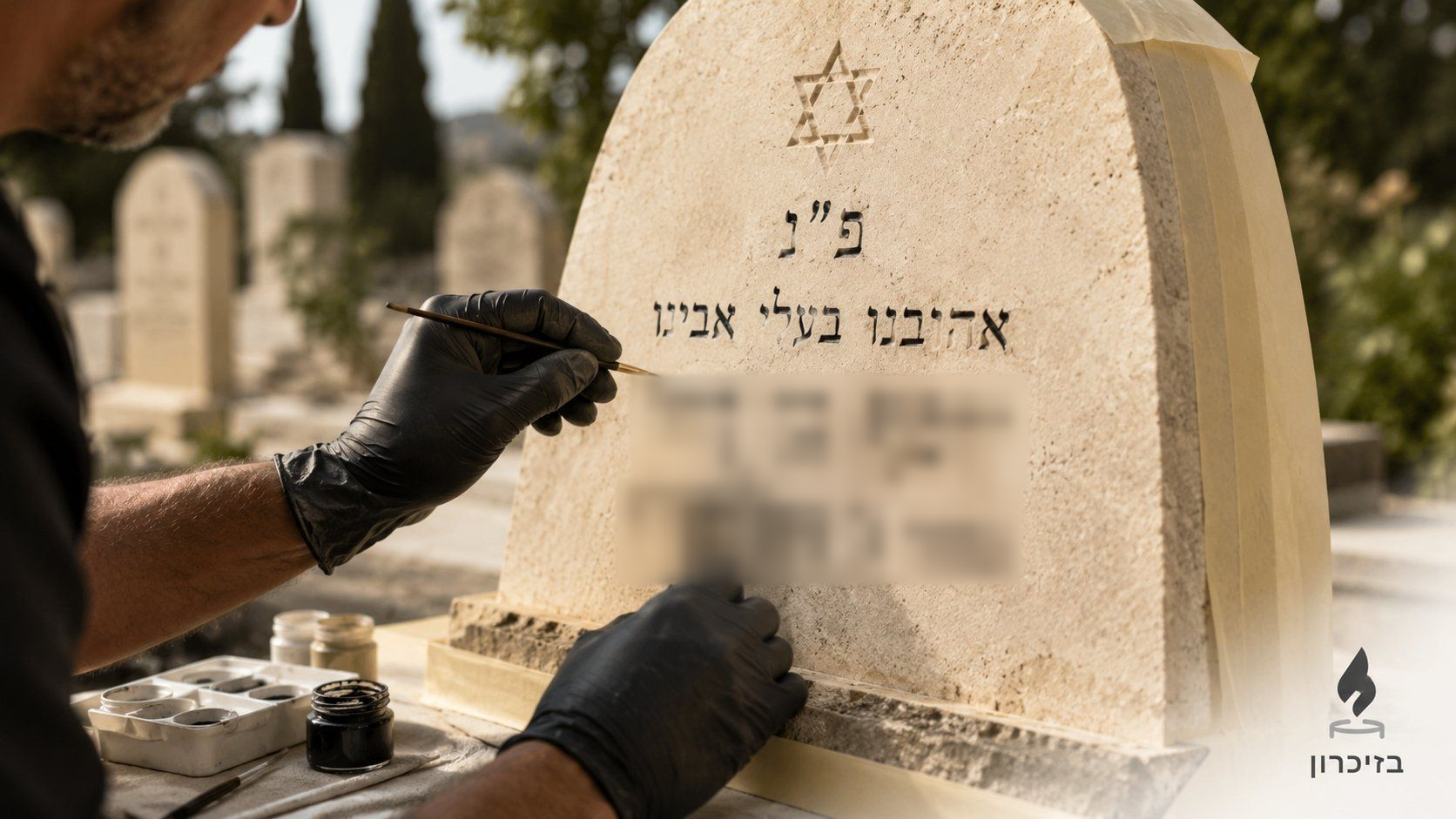
The Inscription: the Heart of the Memorial
When a stone is created, what matters most is not only the shape of the stone, its size, or its overall appearance. The most important element of any memorial is the inscription.
The person's name, the dates of their life, words of remembrance, lines of prayer, or a personal message from the family: these are the elements that make a stone unique and preserve the memory of a family member for years to come.
The quality of the lettering is therefore critical. An inscription must remain legible decades later, despite sun, rain, temperature swings, and the natural aging of the stone. For families abroad, the inscription is often what they look at first in every photo of the plot, which makes its condition all the more important.
Over years of work, Bezikaron's specialists have restored tens of thousands of stones across Israel. Our experience shows that most inscription problems arise not from the age of the stone, but from mistakes made during fabrication, engraving, or letter painting.
The Nature of Hebron Stone
Most stones in Israel are made of Hebron stone, a natural limestone quarried in the Hebron and Jerusalem area.
The stone is known for its warm beige, grey-beige, and softly golden tones, which give stones a natural look that blends harmoniously into the landscape.
Despite its relatively high density, Hebron stone has a porous structure. This is why lettering work must account for the material's characteristics and use the correct engraving and painting technologies.
The Main Types of Stone Engraving in Israel
Several methods are used today to inscribe Hebron stones in Israel.
Hand Engraving
This is one of the oldest inscription methods.
The craftsman prepares a text template and chisels each letter by hand using specialized tools and a mallet.
Handwork demands high skill and a great deal of time. Today this method is rare, used mainly in the restoration of old stones or for bespoke commissions.
The chief advantage of hand engraving is the uniqueness of the result, but its cost and labor intensity greatly limit its use.
Sandblast Engraving
Sandblasting is the most widespread method of inscribing stones in Israel.
A special template with the approved text is applied to the surface of the stone. High-pressure sandblasting equipment then cuts the letters into the structure of the stone.
The technology's main advantage is control over the depth of the engraving. This produces crisp, durable inscriptions that respond well to subsequent painting and restoration.
This is why most modern Hebron stones are made using sandblast engraving.
Laser Engraving
Modern technology allows inscriptions to be applied with laser machines.
A laser offers high precision and can create intricate decorative elements without manual work.
The method has limitations, however. Because the laser does not cut deeply enough into the stone, subsequent painting and restoration of the letters become considerably more difficult.
For this reason, laser engraving is used far less often on stones intended to last for decades.
Lead Letters
A separate technique is lettering made of lead.
The process begins with preparing a template and cutting recesses into the stone. The craftsman then fills the prepared letters with lead, which hardens into the finished inscription.
Many consider this one of the most durable methods, but the quality of the result depends entirely on correct technique.
Only pure lead, free of other metals, must be used. If metallic impurities are present, corrosion and rust marks appear over time, spoiling the stone's appearance.
In addition, each letter must have internal anchor points and seating holes. These are what allow the lead to hold securely inside the stone.
Unfortunately, many makers neglect this step. As a result, within just a few years the letters begin to loosen, fall out, or require restoration.
In the experience of Bezikaron's specialists, most problems with lead letters stem precisely from improper installation technique.
Brass Letters
Another popular lettering technique uses brass letters.
In this case, the letters are fabricated separately and then mounted on the surface of the stone.
The most common manufacturing mistake is fixing the letters with adhesive alone.
However good modern adhesives are, sun, moisture, and time gradually degrade them. The letters begin to detach and fall off.
The correct technology requires creating a dedicated seat for every letter.
A special template is prepared, holes are drilled with precision, and mounting elements are installed. Only then are the letters additionally secured with professional adhesive.
This approach ensures a reliable hold for many years.
Why Inscriptions Lose Their Appearance
Over time, almost any inscription needs restoration.
The condition of the letters is affected by:
- intense solar radiation;
- moisture and temperature swings;
- erosion of the Hebron stone;
- biological contamination;
- the use of poor-quality materials;
- incorrect painting technique.
Specialists very often encounter cases where the original painting was done without surface preparation or without following the technological steps.
As a result, the inscription needs complete restoration within just a few years.
Painting Stone Letters
Quality letter painting is a complex technical process.
Bezikaron uses a special two-component waterproof paint developed for the Israeli climate.
The work proceeds in several stages.
Stage One: Protecting the Surface
Before painting begins, every part of the stone that must not come into contact with paint is masked off.
Stage Two: Degreasing
This is one of the most important preparation steps.
The surface of the letters is thoroughly cleaned and degreased to ensure maximum adhesion of the paint to the stone.
Unfortunately, it is precisely this step that many restorers skip.
Stage Three: Applying the Paint
After preparation, the first coat of paint is applied.
A technical pause of about twenty minutes follows, allowing the material to set properly.
The second coat is then applied, ensuring even color, saturation, and a durable finish.
Stage Four: Final Finishing
Once the paint has dried, the masking materials are removed and the surface is cleaned of excess paint.
It is at this stage that technique matters most.
Overly aggressive abrasion removes the top layer of stone along with the paint. The depth of the letters gradually diminishes.
After several such restoration cycles, the inscription loses definition, and sometimes the entire slab must be replaced.
Bezikaron's specialists use abrasives with precisely selected grit, which remove only the excess paint without damaging the stone or reducing the depth of the engraving.
Restoring Lead Letters
Lead inscriptions also need periodic maintenance.
Over time, oxidation marks, grime, and the natural aging of the metal appear on the surface of the lead.
To restore such inscriptions, the company's specialists use special compounds similar to those used in the jewelry industry for darkening metal.
The process begins with cleaning and removing the products of oxidation.
The surface is then degreased and treated with a special chemical compound that returns contrast and the original appearance to the letters.
The inscription becomes crisp and clearly legible once again.
A Professional Approach to Preserving Memory
The inscription on a stone is the principal element identifying a person and the primary bearer of their memory.
That is why quality engraving, correct letter painting, and timely restoration carry not only aesthetic but deep symbolic meaning.
Bezikaron's years of experience show that most inscription problems can be prevented at the fabrication and installation stage.
Professional technology, quality materials, and competent maintenance keep inscriptions beautiful, legible, and durable for decades, preserving the memory of family members, with dignity, for generations to come.