
Turkish Marble in Israel: Cleaning Marble Stones, Stain Removal, Restoration, and Protection
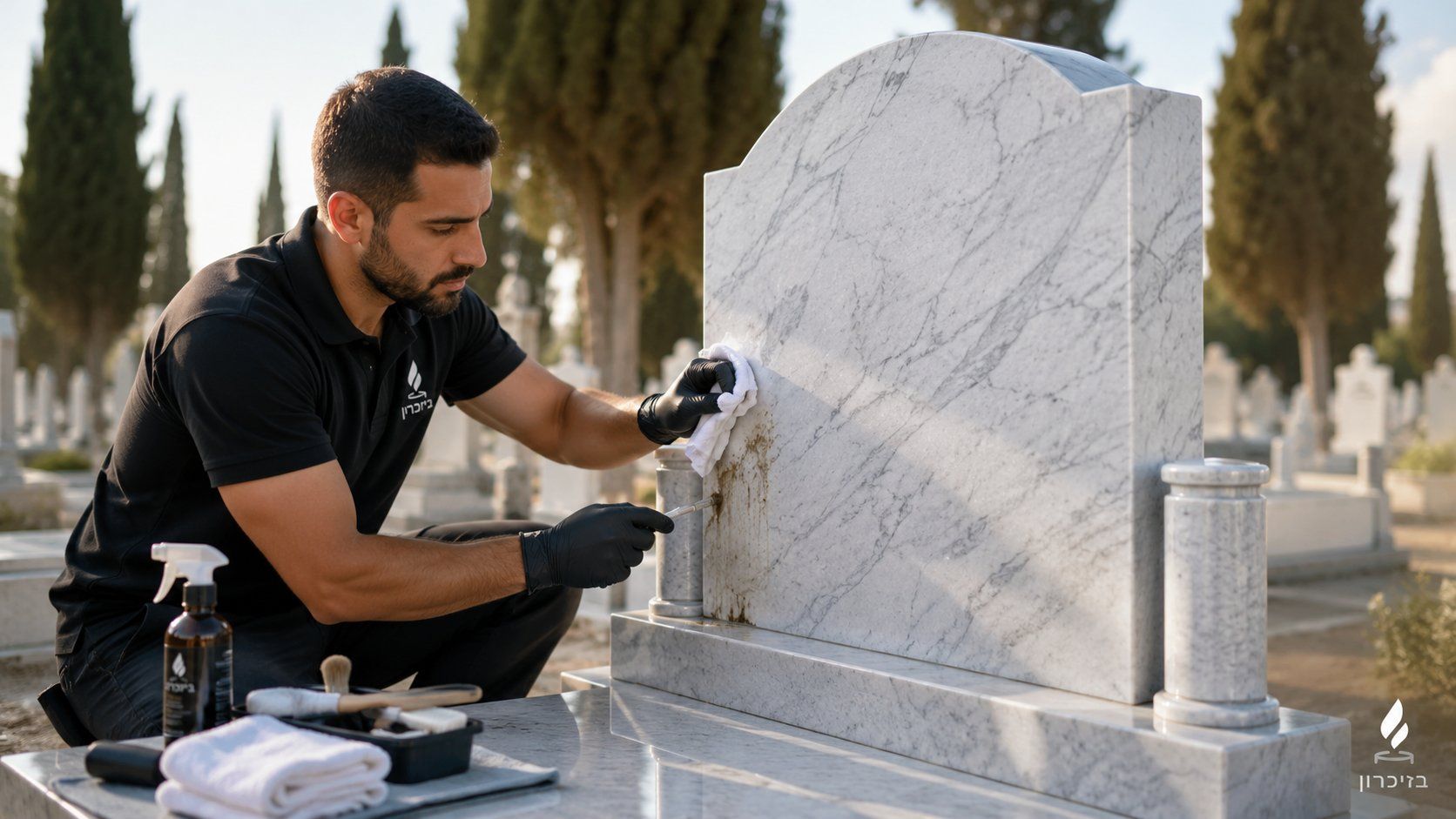
Turkish marble is one of the most popular materials for stones in Israel. Imported from Turkey, it is widely used by Israeli stone makers for its refined appearance, durability, and ability to be combined with other types of natural stone.
Turkish marble most often comes in various shades of grey, with characteristic veins of darker or lighter tone. Each slab is unique, its appearance depending on the particular cut obtained during quarrying and processing. With its natural patterning and depth of tone, Turkish marble looks both noble and contemporary, which is why it is used for solid stones as well as combined memorial structures.
What Makes Turkish Marble Different
Many people assume marble is completely impermeable, a common misconception.
Compared with Hebron stone, Turkish marble is denser and less porous. Even so, its structure contains micropores through which various contaminants can penetrate into the stone.
Problems most often arise from environmental exposure, organic contamination, dust, wax from memorial candles, and various oily substances.
One of the most frequent mistakes is attempting to clean the stone with household products. Many people use ordinary soap or all-purpose cleaners containing fatty components. After such treatment, dark grey stains often remain on the marble surface, gradually penetrating the structure of the stone and becoming extremely difficult to remove.
This is why cleaning marble stones requires a professional approach and specialized materials, particularly important to know if you live abroad and are arranging care for a family plot in Israel remotely.
The Most Common Stains on Turkish Marble
Over years of work, Bezikaron's specialists have identified several types of contamination most characteristic of Turkish marble.
These include:
- wax residue from memorial candles;
- grease stains;
- atmospheric grime;
- organic contamination;
- marks left by improper cleaning;
- mineral deposits;
- orange stains resembling rust.
The last type is especially common.
Such stains can appear due to environmental exposure, contact with biological matter, or improper care of the stone. Over time they become more visible and significantly mar the appearance of the memorial.
Removing stains from marble requires special chemical compounds capable of penetrating the structure of the stone and eliminating not only the visible consequences of contamination but its underlying cause.
Cleaning Marble Stones
Turkish marble demands an entirely different approach from Hebron stone.
While limestone requires the gentlest possible chemistry, the high density of Turkish marble allows the use of specialized professional compounds, including certain acidic components that are safe for this type of stone.
Bezikaron uses a multi-stage cleaning technology for Turkish marble.
Initial Cleaning
The first stage removes surface contamination using high-pressure equipment.
This clears away dust, atmospheric grime, organic deposits, and loose dirt from the surface of the stone.
Applying the Active Compound
Once the surface is prepared, a specialized cleaning compound, selected specifically for Turkish marble, is applied.
The product penetrates the stone's micropores and acts on contamination that ordinary washing cannot remove.
Depending on the condition of the stone, the compound works for 20–30 minutes.
Deep Cleaning
After the chemical reaction is complete, the surface is cleaned again under high pressure.
This stage removes residual contamination: traces of grease, wax, biological growth, and other substances that have penetrated the structure of the stone.
As a result, the stone regains its natural color and original appearance.
Restoring a Marble Stone
Even a high-quality stone is exposed to the environment over time.
Restoration becomes necessary when darkening, ingrained dirt, rust-colored stains, wax marks, scratches, or other surface defects appear.
Comprehensive restoration typically includes:
- deep cleaning;
- stain removal from the marble;
- treatment with specialized chemical compounds;
- resurfacing;
- restoring the stone's original color;
- applying a protective coating.
When the work is done correctly, the stone returns almost completely to its original appearance.
Resurfacing Turkish Marble
Many people mistakenly call this process polishing, but in practice Turkish marble more often undergoes careful resurfacing (honing).
This stage demands particular caution.
Despite its density, Turkish marble is a relatively soft material. Coarse abrasives can leave deep scratches and damage the surface.
That is why Bezikaron's specialists use dedicated abrasive discs with precisely graded grit.
The work proceeds in stages, moving gradually from coarser to finer treatment.
This approach erases the marks of time, levels the surface, and restores the stone's natural beauty without risking damage to the material's structure.
Protecting a Marble Stone for Years to Come
Even a perfectly cleaned and restored stone needs ongoing protection.
Without a quality protective coating, contamination gradually begins to penetrate the stone again, and surface aging accelerates significantly.
To protect Turkish marble, Bezikaron's specialists use a professional Italian-made protective compound developed specifically for natural stone.
Unlike ordinary sealers, this material has enhanced penetrating power and forms long-lasting protection within the structure of the marble.
The effectiveness of this protection, however, depends not only on the quality of the material but on how correctly it is applied.
In our specialists' experience, a single treatment does not deliver the maximum result.
The most effective approach is staged protection of the marble stone, repeated roughly once every six months.
With this system, the protective compound penetrates progressively deeper into the structure of the stone, providing long-term protection against moisture, contamination, and weathering.
This is precisely the approach that keeps a stone in excellent condition for many years, and the reason many families abroad choose a regular care schedule rather than one-off cleaning.
Professional Care for Turkish Marble Stones
Turkish marble is rightly considered one of the most beautiful and sought-after materials for stones in Israel. But its appearance depends directly on the quality of maintenance and proper care.
Household cleaners, improper cleaning, or unsuitable chemical compounds can cause serious damage to the stone.
Professional cleaning of marble stones, timely restoration, stain removal, and quality protection preserve the stone's natural beauty, extend the life of the memorial, and keep the memory of your family dignified for years to come.
That is why caring for Turkish marble stones requires specialized knowledge, experience, and professional technology, which Bezikaron has been refining over many years of work in Israel.