
Turkish Marble in Israel: Engraving, Letter Painting, Raised (Negative) Engraving, and Inscription Restoration
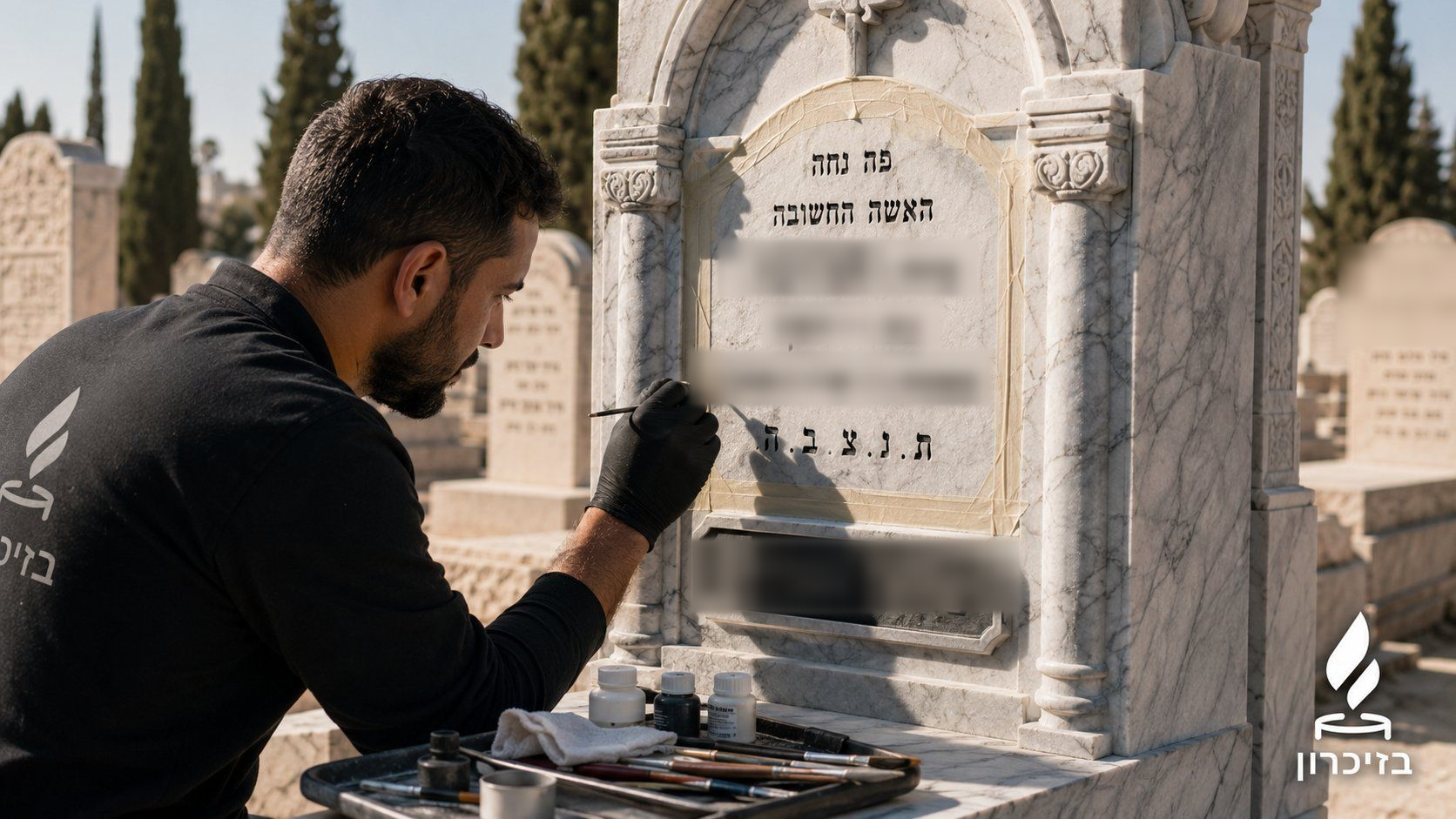
The Inscription: the Heart of the Memorial
Whatever the material of the stone, it is the inscription that remains the central element preserving a person's memory through the years.
The name, the dates of a life, words of remembrance, lines of prayer, or a personal message from the family make every stone unique. That is why the quality, durability, and legibility of the lettering matter so much, especially for families abroad, for whom the inscription in a photograph is often their main connection to the plot.
For many years, Bezikaron's specialists have been restoring inscriptions on stones in Israel, renewing letters on marble, and maintaining memorial complexes. Our experience shows that most lettering problems are linked not to the age of the stone, but to mistakes made during fabrication, engraving, or letter painting.
Turkish Marble and Its Lettering Characteristics
Turkish marble is one of the most popular stone materials in Israel.
The stone has a characteristic grey color with natural veins of darker or lighter shades. Every slab has a unique pattern, making each stone individual.
Compared with Hebron stone, Turkish marble is denser and less porous. Even so, lettering and subsequent restoration must take the specifics of its structure into account.
Despite its strength, incorrect abrasion, unsuitable materials, or unprofessional painting can damage the marble surface and significantly shorten the life of the inscription.
The Main Engraving Methods on Turkish Marble
The technologies for inscribing Turkish marble are essentially the same as those used on other types of stones in Israel.
Hand Engraving
One of the oldest inscription methods.
After preparing a template, the craftsman chisels each letter by hand with specialized tools and a mallet.
Today this method is rare, as it demands high skill and a great deal of time.
Sandblast Engraving
The most common method of inscribing Turkish marble stones in Israel.
A template with the approved text is applied to the surface, and sandblasting equipment then forms the letters in the structure of the stone.
The method's main advantage is precise control over letter depth, which makes the inscription easy to paint and restore later.
Sandblast engraving is considered the most reliable technology for stones meant to last for decades.
Laser Engraving
Modern laser machines can apply inscriptions with high precision and create intricate decorative elements.
But laser technology has its limits.
Because the cut is not deep enough, subsequent restoration and repainting of the letters become considerably more complicated than with sandblast engraving.
For this reason, laser lettering is used less often on stones intended for long-term service.
Raised (Negative) Engraving
Raised (or "negative") engraving deserves special attention; it is widely used on Turkish marble.
This style is considered one of the most striking and prestigious ways of presenting an inscription.
The essence of the technique: the letters themselves remain at the original level of the stone's surface, while the background around them is recessed by sandblasting.
The result is a three-dimensional effect in which the letters appear to stand proud of the stone.
Raised engraving with a recessed background can be executed in the classic sandblast manner or combined with lead letters.
Thanks to the contrast between the recessed background and the raised letters, the inscription looks more expressive and remains legible even from a considerable distance.
Why Painting Raised Engraving Is So Demanding
It is here that one of the most difficult challenges in restoration arises.
After sandblasting, the recessed background becomes far more porous than the polished surface of Turkish marble.
If paint reaches this background while the letters are being painted, it begins to soak deep into the structure of the stone.
Unlike a polished surface, where excess paint can be removed, the porous recessed background absorbs the pigment almost instantly.
Removing it afterward is extremely difficult, sometimes practically impossible.
Painting letters on a marble stone with a recessed background therefore demands high skill, special protective materials, and strict adherence to the technique.
Why You Should Never Paint Raised Engraving Yourself
Bezikaron's specialists regularly see the consequences of do-it-yourself inscription painting.
Even a small amount of paint accidentally reaching the porous background can irreversibly change the stone's appearance.
In some cases, restoring the inscription becomes impossible without replacing the damaged element.
This is why any painting of raised engraving should be entrusted exclusively to professionals experienced with Turkish marble.
Lead Letters on Turkish Marble
One of the classic lettering techniques is lead letters.
After the template is prepared, special recesses are cut into the marble and then filled with lead.
Once it hardens, the surface is finished, excess metal is removed, and the completed inscription remains.
The quality of this work depends directly on the lead used and on correct installation technique.
Every letter must have anchor points inside the stone. Without them, the lead begins to loosen and fall out over time.
In addition, lead containing metallic impurities can develop corrosion and rust marks.
Brass Letters
Another popular technology is brass letters.
In this case the letters are fabricated separately and mounted on the surface of the stone.
The correct technique involves creating a seat for each letter, installing dedicated mounting elements, and additionally securing the letters with professional adhesive.
Only this method ensures a durable and reliable hold.
Painting Letters on Turkish Marble Stones
Bezikaron uses a special two-component paint with high resistance to moisture, ultraviolet radiation, and the Israeli climate.
Before painting, the surface of the stone is carefully masked and the letters are thoroughly degreased.
The first coat of paint is then applied.
A technical pause of about twenty minutes follows.
Once the first coat has dried, a second coat is applied, ensuring color saturation and a durable finish.
After painting is complete, the masking materials are removed and the surface is delicately cleaned of excess paint.
For Turkish marble it is especially important to use the correct grade of abrasive. Coarse abrasives can leave visible scratches on the surface of the stone.
Bezikaron's specialists therefore use dedicated abrasive materials that remove only the excess paint without damaging the stone's surface.
Restoring Letters on Marble
Even a well-executed inscription is exposed to the environment over time.
Sunlight, precipitation, grime, candle wax, and the natural aging of materials gradually reduce the contrast of the letters.
Timely restoration preserves the stone's original appearance and avoids the need to replace the inscription entirely.
To restore lead letters, the specialists use special chemical compounds also employed in the jewelry industry for darkening metals.
After cleaning, removing oxidation, and degreasing, a special compound is applied that returns rich color and crispness to the letters.
Preserving Memory for Years to Come
The inscription on a stone is the principal element identifying a person and the primary bearer of their memory.
That is why quality engraving on Turkish marble, professional letter painting, and timely restoration of inscriptions carry not only aesthetic but deep symbolic meaning.
Professional technology keeps inscriptions beautiful, contrasting, and durable for decades, preserving the memory of family members, with dignity, for generations to come.