
Types of Stones in Israel: Structure, Materials, and Installation Methods
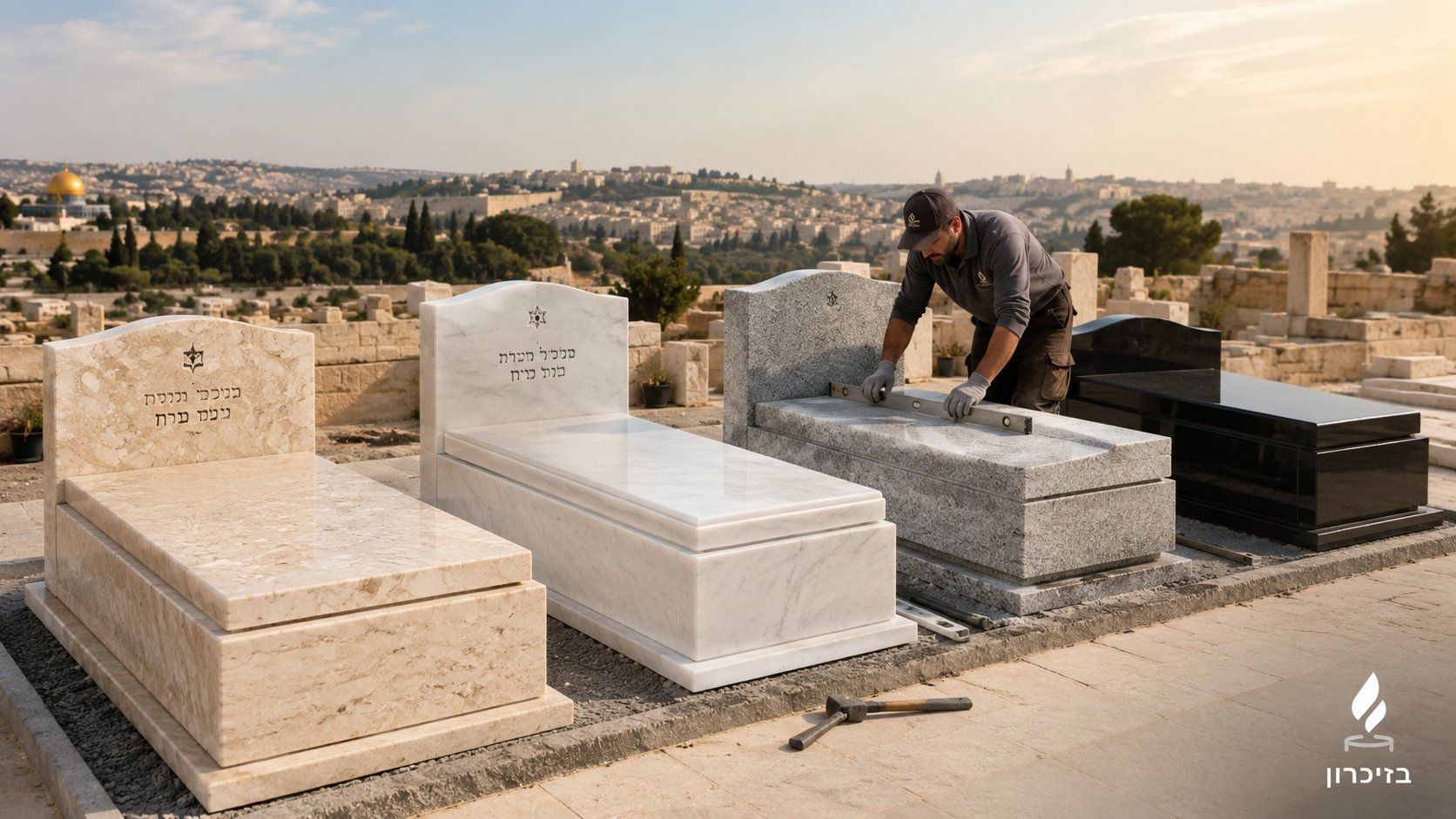
What Makes Israeli Stones Different
Stones in Israel have a distinctive structure that differs noticeably from the memorials commonly seen in other countries.
In the United States, Europe, and elsewhere, stones are often made from a single massive block of stone, a few large elements, or individual memorial plaques. In Israel, the approach is entirely different: a stone is a full multi-part structure assembled from numerous stone slabs.
This structure resembles a sarcophagus and typically consists of 8 to 12 separate elements. Each element has its own purpose, and the entire system is assembled into a single solid form that must remain stable and presentable for many years.
If your family is arranging a stone from abroad, this is the most important thing to understand: installing a stone in Israel requires not just quality stone, but proper engineering, professional assembly, and familiarity with the rules of local sites.
Stone Dimensions and Site Requirements
One key feature of stone installation in Israel is that the dimensions of the future stone are usually dictated by the rules of the specific site.
Most sites have precise standards for the width, length, and height of a stone. These dimensions must be taken into account at the design stage, before the stone slabs are even cut.
That is why it is essential to check the site's requirements in advance, prepare an accurate drawing, and only then begin fabrication.
Mistakes at this stage can mean the finished structure has to be reworked or adapted to fit the constraints of the plot.
A Pre-Prepared Plot
In most cases, the plot in Israel is already prepared in advance.
The plot usually contains a concrete slab with a technical opening. The stone is later installed on this base.
However, the presence of this concrete slab does not mean the stone can simply be placed on top without further preparation.
Proper installation requires building a reliable foundation that can bear the weight of the structure, preserve the stone's geometry, and prevent the slabs from separating in the future.
What Materials Are Israeli Stones Made Of
Stones in Israel can be made from a single type of stone or from several materials combined.
The most common are Hebron stone, Turkish marble, grey granite, and black granite. Combined structures, where different stones are used together, are also very popular.
For example, a single stone may combine:
- Hebron stone and black granite;
- Turkish marble and black granite;
- Hebron stone and Turkish marble;
- grey granite and black granite;
- black granite throughout;
- Hebron stone throughout;
- Turkish marble throughout.
Combined stones allow for a more expressive design, highlighting particular structural elements, inscriptions, or decorative details.
But the more complex the structure and the more materials involved, the more critical the quality of assembly and professional installation become.
Why an Israeli Stone Is a Complex Structure
A stone in Israel cannot be thought of as a simple stone slab.
It is a multi-part structure made up of several stone elements joined together, typically 8 to 12 slabs forming a single memorial sarcophagus.
Each slab must be precisely sized, correctly positioned, and securely fastened.
If even one step is done improperly, the structure may begin to separate over time, lose stability, crack, or become visibly distorted.
This is why the choice of maker and installation team is decisive.
Preparing the Foundation
The first and one of the most important stages is preparing the base.
Reputable makers never install a stone directly onto the existing concrete slab without additional reinforcement. A long-lasting installation requires a properly built foundation.
A correct foundation includes steel reinforcement, quality cement mix, gravel, sand, and the right proportions of materials.
Such a base distributes the load evenly and prevents the stone from settling or tilting.
If the foundation is done poorly, even the most expensive stone will not save the structure from future problems.
Why Stone Slabs Begin to Separate
One of the most common problems with poorly installed stones is slab separation.
This happens when the individual elements are simply glued together or fixed only with cement at the corners.
At first glance, such a structure may look fine, especially right after installation. But over time, under the effects of weight, humidity, temperature swings, and natural stresses, the slabs begin to drift apart.
Gaps appear, the geometry of the stone is compromised, and the structure gradually loses its strength.
In some cases, the stone may require major repair or complete reinstallation. For families overseas, this often means discovering the problem only years later, from a photograph.
Properly Securing the Slabs
Professional installation requires a reliable system for fixing every element in place.
Bezikaron's specialists use dedicated metal brackets at the corners of the stone. These elements bind the slabs together and prevent them from shifting outward.
This is especially important for multi-part stones, where every slab is part of the overall structure.
Proper internal fastening makes the stone more stable, extends the life of the structure, and reduces the risk of gaps opening between the slabs.
The Quality of Adhesives and Bonding Materials
Another important consideration is the choice of materials used to bond the slabs.
Unprofessional makers often use weak or unsuitable compounds that lose strength over time. Voids form between the slabs, the joints open up, and the structure gradually weakens.
Bezikaron uses only strong, professional-grade materials designed for natural stone and memorial structures.
These compounds reliably seal cavities, bind the elements together, and ensure the durability of the entire structure.
Combined Stones: Beauty and Complexity
Combined stones look especially striking, but they demand even greater precision.
When different types of stone are used in a single structure, their density, weight, porosity, thermal behavior, and response to humidity must all be taken into account.
Hebron stone, Turkish marble, and black granite, for example, have very different physical properties. Joining them incorrectly can lead to cracks, opening joints, or uneven aging of the structure.
Professional installation prevents these problems and keeps the stone in dignified condition for many years.
How to Choose the Right Stone Maker
When choosing a maker, it is important to look beyond the appearance of the stone and the price.
What matters far more is how exactly the installation will be carried out.
It is worth clarifying in advance:
- whether an additional foundation will be prepared;
- whether steel reinforcement is used;
- what materials are used for the base;
- how the slabs are joined to each other;
- whether metal brackets are used at the corners;
- which adhesives and bonding compounds are applied;
- whether the requirements of the specific site are taken into account;
- whether the maker has experience with combined stones.
A good stone is not just beautiful stone. It is correct structure, a reliable foundation, and professional assembly.
Professional Stone Installation in Israel
Israeli stones have a complex multi-part structure, so their installation demands experience, precision, and an understanding of local conditions.
A stone must be not only beautiful but solid. It must withstand the climate, hold its shape, keep its slabs together, and not require constant repair.
Bezikaron works with every type of stone in Israel: Hebron stone, Turkish marble, grey granite, black granite, and combined materials.
A professional approach to the foundation, internal fastening, bonding materials, and overall assembly produces a stone that retains its dignity and stability for many years.
Preserving Memory Begins with the Right Structure
A stone is not just stone. It is a place of memory, respect, and a family's connection to a family member.
That is why it must be made and installed correctly from the very beginning.
A quality foundation, securely bonded slabs, the right materials, and professional assembly prevent most future problems.
A properly installed stone preserves not only its shape and appearance, but what matters most: a dignified memory of a person, for years to come.